
Why I Made a Dozen Jars of Spice Tincture
There’s a mistake waiting for every new mead-maker who gets excited about flavor: you smell a jar of cardamom, imagine it in your mead, and dump it straight into the fermenter. Then you wait a month to find out you were wrong. You can’t taste-and-stop, you can’t take it back out, and the fermentation’s CO₂ has been scrubbing the delicate aromatics out the airlock the whole time.
There’s a better way, and this week I committed to it properly: tinctures.
The idea
A tincture is just a spice steeped in neutral alcohol until the alcohol has pulled the flavor out. Instead of guessing in the fermenter, you extract each spice separately, into its own little bottle. Then, when the mead is finished, you run a bench trial: pour a few small tasting glasses of the mead and add measured drops — this tincture here, that one there — until you find the blend by taste. Scale the winning drop-count up to the whole batch, and you’re done.
The magic word is reversible. Overshooting becomes impossible, because you’re building the flavor a drop at a time in a two-ounce glass instead of committing blind to a gallon.
What it’s for
The immediate reason is a mead I’ve got coming — a metheglin, which is just the old word for a spiced mead. But not the sweet, mulled, holiday kind. I’m after something drier and more aromatic, closer to a gin: green cardamom out front, ginger, bright citrus peel, a little pepper, maybe a whisper of juniper. Every one of those is a spice I want to be able to dial in precisely, which is exactly the job tinctures are built for.
The rules I’m following
A few things I learned before loading the jars:
- Proof beats brand. The alcohol is the solvent — the more of it (and the less water), the better it pulls oils and resins out of hard spices. A clean 100-proof vodka out-extracts any fancy 80-proof. You’re not tasting the vodka; it ends up as drops in the mead. So: mid-shelf, high-proof, done. (I used 100-proof.)
- Toast the hard stuff, never the delicate stuff. A quick dry-pan toast blooms the oils in hard seeds — allspice, star anise, clove. But heat drives off exactly what you want from citrus peel and anything floral, so those go in raw.
- Taste early, especially citrus. Citrus peel turns bitter if it steeps too long. Most of these get pulled the moment they taste bright and true, not “as long as possible.”
The library
Here’s where it went from “a couple of tinctures” to “clear the shelf.” Since I had the vodka open and I’m not going to drink it, I figured I’d build a whole library at once — spices keep almost indefinitely in high-proof alcohol and amber glass, so every jar I make now is an option I’ll have for years of future batches.
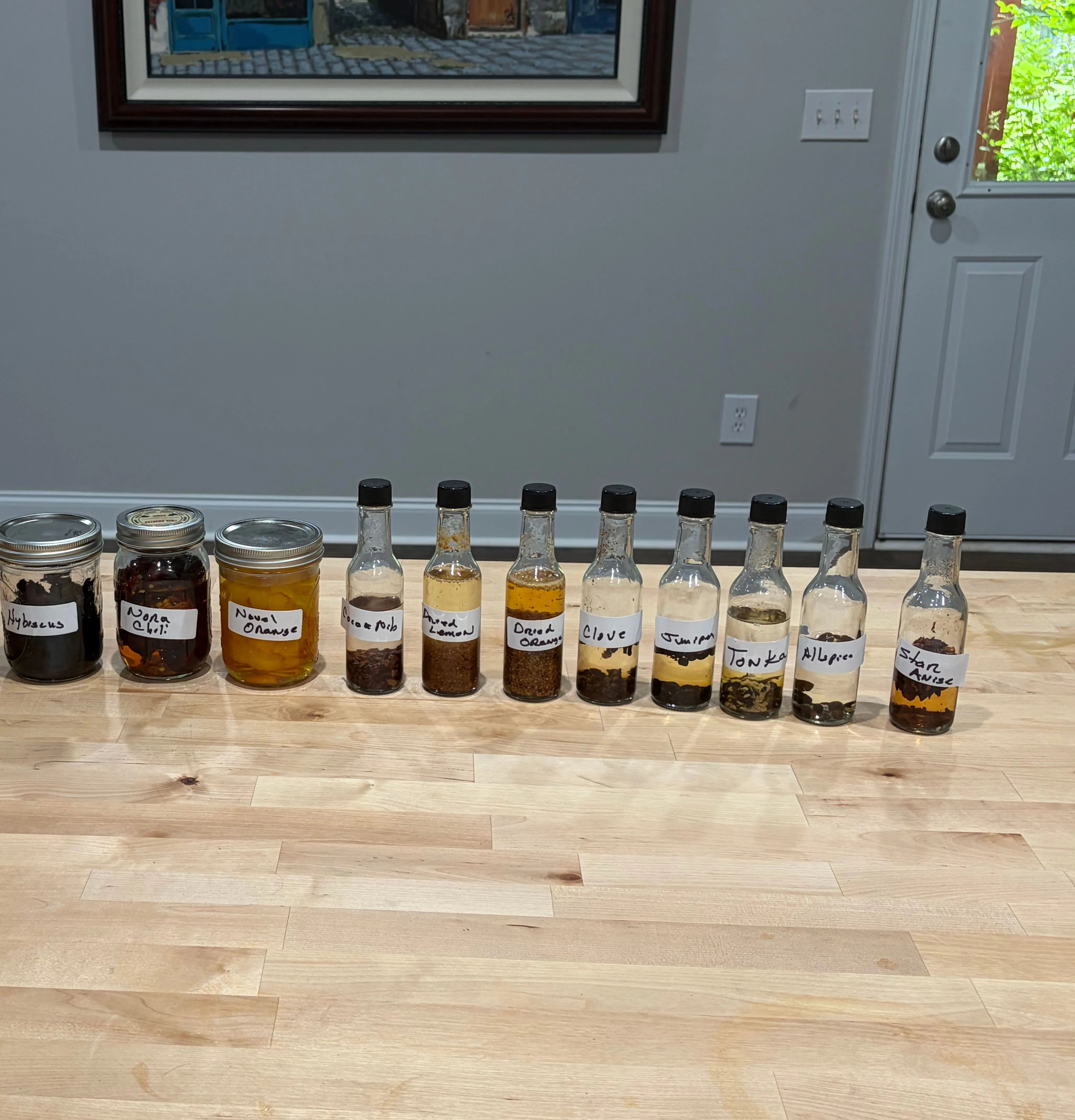
This first run is a dozen jars, and you can read most of them right off the labels: fresh navel orange and Meyer lemon peel; dried orange and dried lemon; hibiscus; cacao nib; clove; juniper; allspice; star anise; a Tonka bean (a gorgeous vanilla-almond aroma — used in single drops, because it’s potent); and a Ñora chili — a mild, sweet, fruity Spanish pepper, in for color and character rather than heat.
The metheglin’s own lead spices — cardamom, ginger, fresh peppercorn — go into the next batch of jars, because they need the longest steep and I want them peaking right when the mead is ready for its bench trial.
That’s the real shift in how I’m thinking about flavor now: not what do I add to the fermenter, but what options do I want on the shelf when it’s time to taste. The fermenter is a commitment. The bench trial is a conversation.